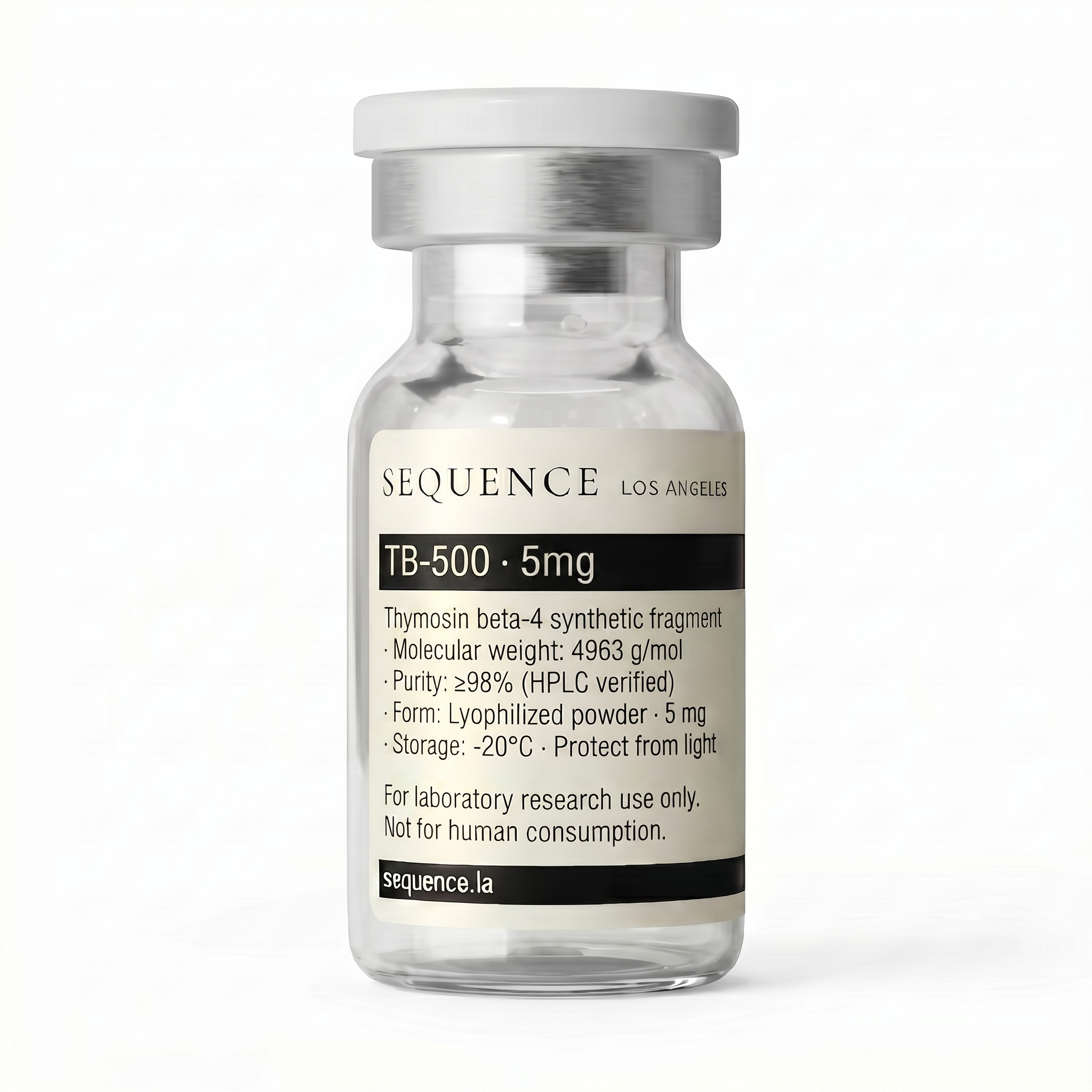
TB-500
Repair & cellular mobility


Wounds closed faster and new blood vessels formed at injury sites in animals given TB-500. The peptide helped cells migrate to where they were needed most.
Ann N Y Acad Sci, 2007
Read the study ↗Published in Nature: heart cells survived at higher rates and damaged cardiac tissue showed signs of repair in animals treated with thymosin beta-4.
Nature, 2004
Read the study ↗Size
Quantity
Purchase frequency
In stock · Ships within 24 hours
Third-party
tested
Free shipping
over $75
COA
included
Reconstitution: Add 2mL bacteriostatic water per 5mg vial (2.5mg/mL). Reconstituted solution should be stored at 2-8°C and used within 30 days. Unreconstituted vials: -20°C. Refer to your institutional protocol for specific preparation requirements.
For laboratory research use only. Not for human consumption.
Purity
≥98%
Molecular weight
4963 g/mol
Form
Lyophilized powder
Storage
Store at -20°C. Protect from light and moisture.
Amino acid sequence
Wounds closed faster and new blood vessels formed at injury sites in animals given TB-500. The peptide helped cells migrate to where they were needed most.
Philp D, et al. — Ann N Y Acad Sci, 2007↗
Published in Nature: heart cells survived at higher rates and damaged cardiac tissue showed signs of repair in animals treated with thymosin beta-4.
Bock-Marquette I, et al. — Nature, 2004↗
Independent lab results — HPLC purity and mass spectrometry identity confirmation.
Download COA (PDF) ↗HPLC purity verified
Mass spec ID confirmed
Batch-specific COA
Published COA before purchase
PubMed citations on PDP
What purity level is this?
Every batch is verified at ≥98% purity via HPLC analysis by an independent laboratory.
What is the difference between 5mg and 10mg?
Same peptide, double the quantity. The 10mg vial is $8.90/mg vs $9.80/mg for 5mg.
How should I store this?
Unreconstituted: -20°C. Reconstituted: 2-8°C, use within 30 days.


Wounds closed faster and new blood vessels formed at injury sites in animals given TB-500. The peptide helped cells migrate to where they were needed most.
Ann N Y Acad Sci, 2007
Read the study ↗Published in Nature: heart cells survived at higher rates and damaged cardiac tissue showed signs of repair in animals treated with thymosin beta-4.
Nature, 2004
Read the study ↗TB-500
Repair & cellular mobility
Size
Quantity
Purchase frequency
In stock · Ships within 24 hours
Third-party
tested
Free shipping
over $75
COA
included
Reconstitution: Add 2mL bacteriostatic water per 5mg vial (2.5mg/mL). Reconstituted solution should be stored at 2-8°C and used within 30 days. Unreconstituted vials: -20°C. Refer to your institutional protocol for specific preparation requirements.
For laboratory research use only. Not for human consumption.
Purity
≥98%
Molecular weight
4963 g/mol
Form
Lyophilized powder
Storage
Store at -20°C. Protect from light and moisture.
Amino acid sequence
Wounds closed faster and new blood vessels formed at injury sites in animals given TB-500. The peptide helped cells migrate to where they were needed most.
Philp D, et al. — Ann N Y Acad Sci, 2007↗
Published in Nature: heart cells survived at higher rates and damaged cardiac tissue showed signs of repair in animals treated with thymosin beta-4.
Bock-Marquette I, et al. — Nature, 2004↗
Independent lab results — HPLC purity and mass spectrometry identity confirmation.
Download COA (PDF) ↗HPLC purity verified
Mass spec ID confirmed
Batch-specific COA
Published COA before purchase
PubMed citations on PDP
What purity level is this?
Every batch is verified at ≥98% purity via HPLC analysis by an independent laboratory.
What is the difference between 5mg and 10mg?
Same peptide, double the quantity. The 10mg vial is $8.90/mg vs $9.80/mg for 5mg.
How should I store this?
Unreconstituted: -20°C. Reconstituted: 2-8°C, use within 30 days.

TB-500
Key Benefits
Cell migration
Promotes endothelial cell migration to sites of tissue damage in animal models.
Blood vessel formation
Studied for angiogenesis — the formation of new blood vessels at injury sites.
Cardiac tissue
Published in Nature for effects on cardiac cell survival and repair.
Versatile
Present in virtually all mammalian tissue — studied across multiple organ systems.
Peer-reviewed research
Top Published Studies
These citations are from peer-reviewed journals. Sequence does not make therapeutic claims.
Peptide science
How It Works
Step 1
Receptor binding
TB-500 binds to specific cell surface receptors, triggering a defined downstream signaling cascade. Each peptide targets a unique receptor profile.
Step 2
Signal activation
The receptor interaction activates intracellular pathways that regulate gene expression, protein synthesis, and cellular behavior in the target tissue.
Step 3
Biological response
TB-500 is a synthetic fragment of thymosin beta-4, a naturally occurring peptide involved in actin regulation. It promotes cell migration by upregulating actin polymerization, enabling cells to move to sites of injury. In preclinical models, it activates integrin-linked kinase (ILK), a key cell survival signaling pathway.

Community sentiment
4.6
3 discussions
From r/Peptides and r/Nootropics
Community discussions. Not endorsed by Sequence. Individual experiences do not constitute research evidence.
TB-500 is the one I keep coming back to. The angiogenesis research is compelling — it literally helps your body build new blood vessels to injured areas. Published in Nature, not some random journal.
Stacked TB-500 with BPC-157 for a partial ACL tear. 8 weeks. MRI showed significant improvement. My ortho was surprised. Not medical advice, just sharing my experience.
The Bock-Marquette 2004 Nature paper on thymosin beta-4 and cardiac repair is genuinely groundbreaking. TB-500 is the synthetic fragment most commonly used in follow-up research.